Multiplication in Scientific Notation
Scientific Notation is based on powers of the base number 10.
The number 123,000,000,000 in scientific notation is written as :
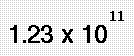
The first number 1.23 is called the coefficient. It must be greater than or equal to 1 and less than 10.
The second number is called the base . It must always be 10 in scientific notation. The base number 10 is always written in exponent form. In the number 1.23 x 10¹¹ the number 11 is referred to as the exponent or power of ten.
Rules for Multiplication in Scientific Notation:
1) Multiply the coefficients
2) Add the exponents (base 10 remains)
Example 1: (3 x 10⁴)(2x 10⁵) = 6 x 10⁹
What happens if the coefficient is more than 10 when using scientific notation?
Example 2: (5 x 10 3) (6x 10³) = 30. x 106
While the value is correct it is not correctly written in scientific notation, since the coefficient is not between 1 and 10. We then must move the decimal point over to the left until the coefficient is between 1 and 10. For each place we move the decimal over the exponent will be raised 1 power of ten.
30.x106 = 3.0 x 10⁷ in scientific notation.
Example 3:
(2.2 x 10 4)(7.1x 10 5) = 15.62 x 10 9 = 1.562 x 10 10
Example 4:
(7 x 10⁴)(5 x 10⁶)(3 x 10²) = 105. x 10 12 --now the decimal must be moved two places over and the exponent is raised by 2. Therefore the value in scientific notation is: 1.05 x 10 14
Now Try these:(write your answers in the form of coefficientx10^exponent) If your answer is 3.5 x 10 3 you should type 3.5x10^3 in the box then click the submit button).
What happens when the exponent(s) are negative?
We still add the exponents, but use the rules of addition of signed numbers.
Example 5: (3 x 10 -3) (3x 10⁻³) = 9. x 10-6
Example 6: (2 x 10 -3) (3x 10⁸) = 6. x 105
Now Try these:
(write your answers in the form of coefficientx10^exponent) If your answer is 3.5 x 10 3 you should type 3.5x10^3 in the box then click the submit button). Multiply the following:
Go to Division in Scientific Notation
Scientific Notation
Introduction to Scientiic Notation: Learn the basic principles of scientific notation. Convert standard numbers to scientific notation.
Scientific Notation Generator: Javascript program will enable you to practice converting any number from basic notation to scientific notation.
Multiplication with Scientific Notation: Learn multiplication using scientific notation, with positive and negative exponents.
Division with Scientific Notation: Learn division using scientific notation with positive and negative exponents.
Word Problems using Scientific Notation: Mixed multiplication/division problems, word problems using scientific notation.
An Integrated Math Science and Art (STEAM) Activity- Mass, Volume Density Activity using the Gates Project from Central Park NYC.