What is the difference between mass and weight?
Try this exercise!
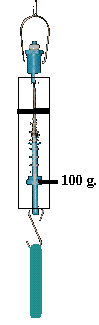
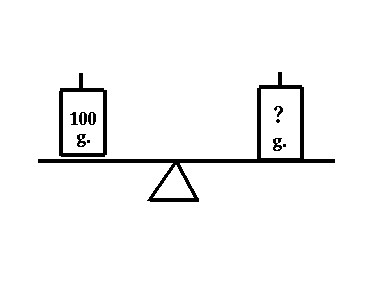
Shown below are two types of scales commonly used in the classroom --a spring scale (left) and a simple balance beam scale on the right.
On earth the spring scale reads 100g with an unknown mass attached at the bottom. To balance the scale on the right a 100g mass was also needed.
If we were to take both scales to the moon, what would the the spring scale read? How much mass would be needed to balance the 100g mass on the balance beam? Can you explain your answer? See if you are right by completing the questions below.
 |
 |
|
spring scale |
simple
balance scale |
On the moon the spring scale on the left would read:
If you need a calculator one is available. Click on calculator in right frame.
What is the scale on the left really measuring (type one word and only in lower-case letters?
What did the above experiment demonstrate? It shows that the scale on the left was measuring the force of gravity (weight) not mass. On earth the spring was standardized to read 100g at sea level. A true balance beam (like a triple beam balance you use at school) measures mass by balancing the scale against a known (standardized) mass. On the moon the mass on the left side of the balance may 'exert less force', but then less force will be needed to balance it.
So what is really mass and weight if they are not the same thing?
Mass is defined as the amount of matter an object has. One of the qualities of mass is that it has inertia As an example of inertia, imagine an ice puck resting on a frozen pond. It takes a certain amount of force to set the puck in motion. The greater the mass the more force will be needed to move the puck. The same is true if the puck were sliding along the ice. It would continue to slide until a force is applied to stop the puck. The more massive the puck is, the more force will be needed to stop the motion of the puck. Mass is a measure of how much inertia an object shows.
The weight of an object on earth depends on the force of attraction (gravity) between the object object and earth. We can express that force as an equation:
F = G[M m/r2] ,
where F is the force of attraction, M is the mass of the earth, m is
the mass of the object, and r is the distance between the center of mass of the
two objects (G is called the Gravitational Constant)
What does this equation show? What will cause the force of attraction to increase or decrease? If either mass increases the force of attraction increases proportionally. Since the moon has 1/6 the mass of earth, it would exert a force on an object that is 1/6 that on earth.
Why is the 1/r 2 factor so important? This is an inverse square relationship which seems to show up a lot in physics. How does it affect the force?
What is 1/r 2 when r=1, 2, 5, 10? What is the decimal equivalent? Notice that when r=1 the value 1/r 2 is 1.0, but at r=10 it deceases to 1/100. That means gravity gets weak 'quick' as we move away from the earth.
To get a real feel for the inverse square relationship, see if you can get two magnets. Move the poles closer and closer slowly, what do you notice when r (the distance between the poles) is very small?
- - -Or return to the Science and Math Activity Home Page
Mass Volume Density Activities
Mass: Learn how to measure the mass of an object using a triple beam balance
Mass vs. Weight: Mass and weight are often confused by many students. Learn the difference and try some challenging problems.
Volume: Measure volume using a graduated cylinder.
Density of a Solid: Learn to calculate the density of an unknown solid from knowing its mass and volume.
Density of a Liquid: Learn to calculate the density of an unknown liquid from knowing its mass and volume using a graduated cylinder and triple beam balance. Learn what a hydrometer is, and what it can do.
Density Challenge: Great page for gifted and talented students! Some excellent challenging problems.
Assessment: Twenty questions on mass, volume and density (two levels of difficulty). Your test is marked online.
Science Project Ideas: Ideas for science projects using mass, volume and density concepts learned from this module.
Mass Volume Density Lab Exercise: Problem: What is the relationship between water pressure and depth of water?
Why does ice float? Why does ice float in water?
An Integrated Math Science and Art (STEAM) Activity- Mass, Volume Density Activity using the Gates Project from Central Park NYC.